
Google Keep vs Apple Notes full breakdown explained simply
I keep both apps on my phone even though I’ve tried multiple times to delete one. Something always pulls me back in. A shopping checklist from my partner that came in via Apple Notes. A voice note I recorded into Keep after a dentist appointment (while half-numb and feeling philosophical). Neither app is perfect, but they’ve buried themselves in different corners of my life.
Here’s what has actually happened when I’ve tried using Keep and Apple Notes for real things 👇
1. How syncing behavior completely changes how useful they feel
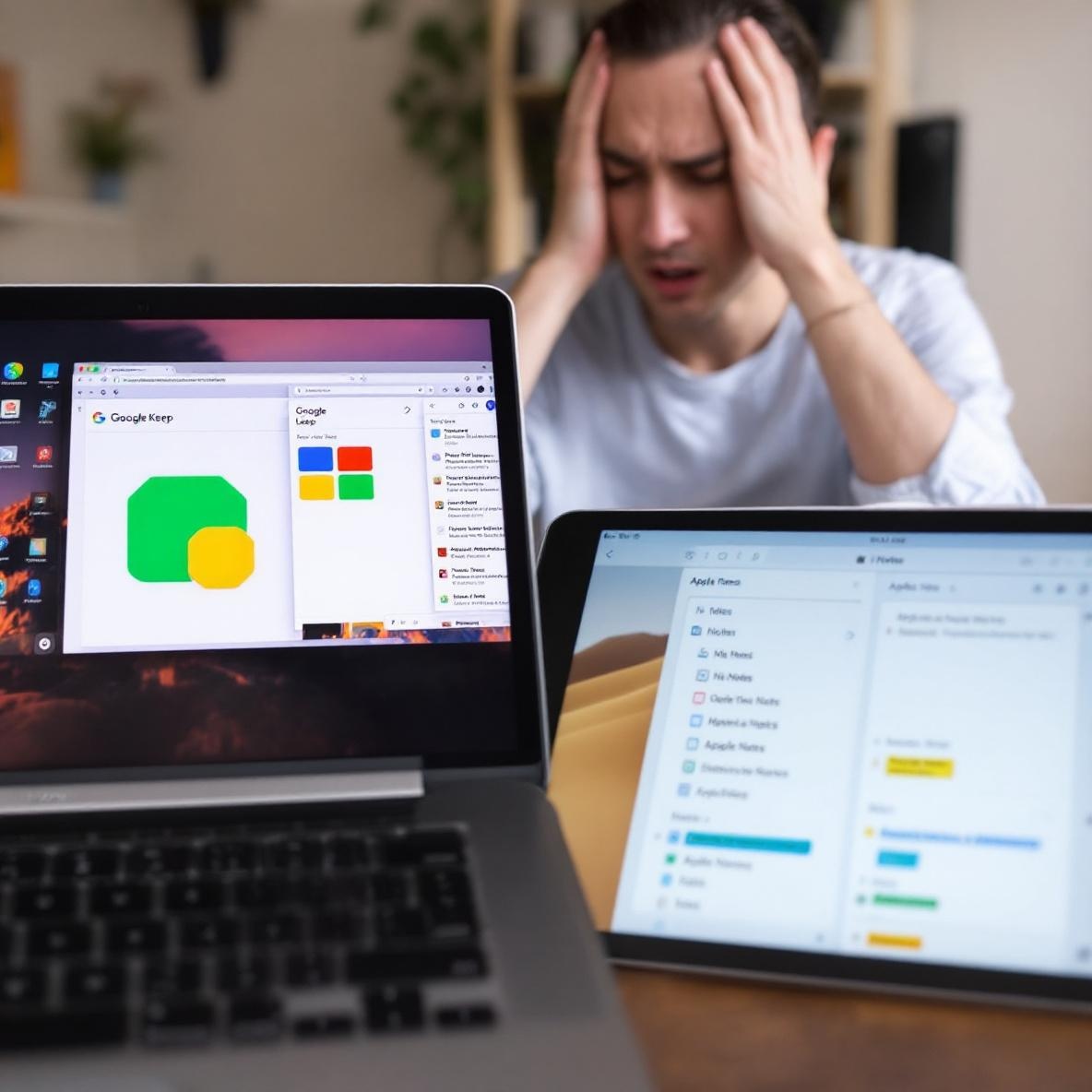
When I first tried switching from Apple Notes to Google Keep full-time, the syncing felt instant. Like freakishly responsive. I’d type on my laptop and the edit would appear on my phone mid-keystroke. This helped a lot for drafting action plans in meetings where I was switching between devices.
But Keep’s sync has one very unpredictable downside. If you’re offline even briefly on mobile and start messing with a note, Google Keep sometimes spawns weird duplicates instead of syncing the changes. These duplicated notes contain partial edits or, worse, old versions. There’s no version history either. I lost an entire brainstorm this way during a flight 🙁
Apple Notes, by contrast, syncs slower—especially across non-matching Apple IDs—but is more conservative. It holds changes until it’s sure all devices are online and using the same iCloud account. It won’t let you edit a shared note if it can’t confirm syncing properly. Which is annoying… but also kind of safer for high-stakes situations.
Apple Notes does versioning on shared notes, which saved me once when my coworker accidentally formatted a partner’s feedback into Comic Sans. True story.
2. Formatting freedom and when it does not matter
If you ever try importing a messy bulleted list into Google Keep, get ready for disappointment. Keep does not support rich text. Not bold, not italics, not even proper spacing. You get one font, one line structure, and a few pastel colors. That’s it.
Sounds bad, but here’s why I didn’t hate it.
I noticed Keep worked best when I didn’t care about perfection—like mid-thought TV ideas, fast grocery items, or logging random package delivery errors. Quick, immediate stuff. Formatting would’ve just slowed me down.
Apple Notes, however, lets you:
– Make title and heading levels
– Add checklists with indentation
– Paste full links with preview summaries
…which is awesome when I’m planning something layered, like a camping weekend with three people’s gear lists. I can copy/paste in screenshots, location links, and even a photo of my friend’s bear spray (lol, yes that happened). None of that’s possible in Keep.
But God forbid you try pasting in markdown to Apple Notes. It ignores all markdown formatting completely and sometimes mangles the spacing. I once pasted a Notion export—it looked like someone sat on my keyboard.
3. Shared notes friction that might break an entire workflow
This is where things got ugly. So, Google Keep allows sharing note-by-note. You invite someone via email, and boom, you can both edit freely. Sounds decent? Sort of. There are two catch-22s:
1. Anyone you share your Google Keep note with must have a Google account *and* be logged into that EXACT email.
2. There’s zero visibility into who made what change or when.
We were sharing a bug triage list in Keep and someone (we never figured out who) deleted half the entries thinking it was “an old version.” Since there’s no change log or history, there was no going back.
Apple Notes sharing is tighter IF—big if—you all live in the Apple bubble. On the same iCloud family or company domain? It’s amazing. Drop a note in, tag someone, they get a ping. You can even highlight changes and comments inline. My partner and I used it to tag to-dos for our move. It was almost as smooth as Google Docs.
But try adding a Windows user or anyone with no Apple device? Not happening. I invited my Android-using project manager to a food plan doc, and all he saw was a grayed-out permission error.
Also—this really drove me nuts—Apple Notes will sometimes BLOCK changes when your iCloud storage is full. Even if you’re doing something basic like ticking off a checklist. Happened at a grocery store 🫠
4. Mobile vs desktop experience flip flops unexpectedly
Apple Notes on macOS is surprisingly powerful—better than the iPhone app in some ways.
You can do things like organize huge notebooks with drag-and-drop folders, insert PDFs and images via Finder, and easily export notes as PDFs (not possible on iPhone unless you screenshot). But that same Apple Notes Mac app gets real glitchy with search. I tried finding a note with the phrase “dental surgery jelly beans” (don’t ask), and nothing came up. But typing the same phrase on my iPhone showed it instantly. This inconsistency is maddening.
Meanwhile, Google Keep on desktop feels like it barely exists. It opens in this weird mini layout inside Gmail or as its own weirdly spaced page with oversized labels. But…the search just works. No lag, no dead ends. Type three words and it shows every note with that combo, even if they’re from four years back.
I pinned some old HTTP error notes in Keep from 2021. Still findable.
Oh, and there’s one ultra-annoying thing: Keep doesn’t let you natively lock or password-protect any note. That feature doesn’t exist. I once stored a few login hints in there—not full passwords, just hints—and ended up deleting them because it felt risky. Apple Notes, on the other hand, lets you Face ID lock any note. Game changer when I’m noting gift ideas or confidential call summaries.
5. Real tips that saved me sanity switching between them
Here’s a list of stuff I learned the hard way 👇
1. In Apple Notes, long-tapping the Share icon (on iPhone) gives you a direct copy-to-link iCloud option. Less clunky than using Messages.
2. In Google Keep, making a label like “.snooze” forces starred notes to bubble up in search.
3. You can’t search inside voice recordings in Apple Notes. So, if you audio journaled something important, add a text summary or you’ll never find it again.
4. Google Keep doesn’t support multifolder sorting—notes can only live in one label. Totally busted my idea of cross-tagged topics.
5. Apple Notes sometimes creates broken thumbnails when you drag screenshots from Desktop. They’ll look fine but won’t open. You need to reupload them manually.
6. You can batch-change label colors on Google Keep by installing Keep Chrome extension (I used one from Glutanimate on GitHub once—it was sketchy but worked).
7. Want to export all Google Keep notes at once? You can only do that through Google Takeout. Expect a giant ZIP that includes weird JSON files for each note.
Honestly, I now just choose based on what mood I’m in. If I’m wearing sweatpants and thinking about hiking snacks: Keep. If it’s a new client strategy session: Apple Notes. Sometimes dumb decisions work fine ¯\_(\u30c4)_/¯